



Clark Tanks Water Tanks - QLD, NSW, VIC
Better Design. Better Build. Better Value. Call 1800 ClarkTanks (1800 252 758)

Water Tank Installation

Li-Lo Underground Rainwater Tank

Li-Lo Underground Water Tank Instructions
Li-Lo Installation Manual
(HTML Version |
PDF 1.1 MB)

Underground water tanks

Above Ground Water Tanks
Site preparation and maintenance


Correct
method for
sitting above
ground

clarktanks sitepreparation main
clarktanks sitepreparation 1

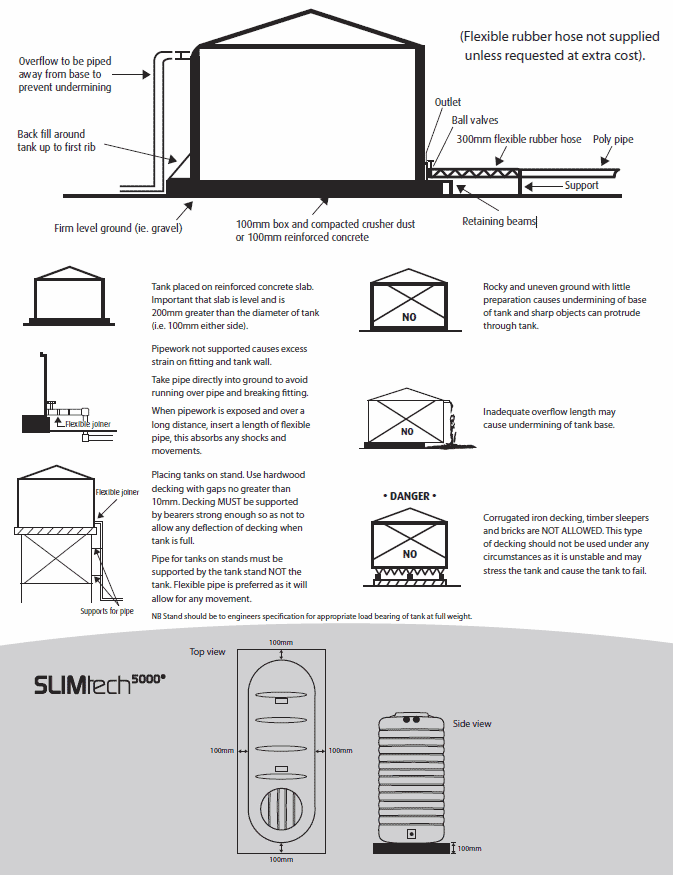
Tank placed on reinforced concrete slab. Important that slab is level and is greater than the diameter of tank.


clarktanks sitepreparation 2

Pipework not supported causes excess strain on fitting and tank wall.

Take pipe directly into ground to avoid running over pipe and breaking fitting.

When pipework is exposed and over a long distance, insert a length of flexible pipe, this absorbs any shocks and movements.


clarktanks sitepreparation 3

Placing tanks on stand. Use hardwood decking with gaps no greater than 10mm. Decking MUST be supported by bearers strong enough so as not to allow any deflection of dec king when tank is full.

Pipe for tanks on stands must be supported by the tank stand NOT the tank. Flexible pipe is preferred as it will allow for any movement.


clarktanks sitepreparation 4

Rocky and uneven ground with little preparation causes undermining of base of tank and sharp objects can protrude through tank.


clarktanks sitepreparation 5

Inadequate overflow length may cause undermining of tank base.


clarktanks sitepreparation 6

Corrugated iron decking, timer sleepers and bricks are NOT ALLOWED. This type of decking should not be used under any circumstances as it is unstable and may stress the tank and cause the tank to fail.


Ensure the location of the tank is level, stable ground which has uniform compaction (free of soft spots). Do not locate large water tanks close to retaining walls or embankments without first consulting a professional engineer to ensure the ground is capable of supporting the weight of the full tank.

  1. Ensure the surface of the site is free from sharp objects or stones and is compacted.
  2. Spread a thin layer (approx. 20-40mm) of 3mm metal/crusher dust – bedding sand can be used but is prone to erosion – evenly over the level ground, at least 500mm more than the diameter of the tank. Once it is compacted and level you may then place the tank directly on top of this material. To assist with reducing soil erosion, back fill to first rib.
  3. Specifications for slab for 10,300 gal and 8,000 gal tanks:
    • Slab must be at least 150mm bigger then the base diameter of the tank
    • Slab must be at least 150mm thick with 2 layers of F82 mesh 75mm apart and a thickening of 200mm wide and 200mm deep with Y16 reo bar at the bottom of the thickening around the edge of the slab
    • Slab must be 32 mpa concrete mix
    • Ensure all plumbing from the outlets is well supported and cannot be knocked.
  4. Ensure the metal/crusher dust is contained under the tank at all times and cannot be washed away. This can be achieved by diverting all run-off water away from the site and retaining the metal/crusher dust with some form of retaining structure e.g. cement strip, rocks or sleepers.
  5. A flexible coupling must be fitted to each outlet to validate the guarantee.
  6. For stand applications, ensure the stand is designed to carry the weight of a full tank. Support slats on the stand should be no further than 20mm apart.
  7. For concrete slab applications, the slab must be at least 15cm wider than the base diameter of the tank and at least 15cm thick with 2 layers of F82 mesh 75mm apart and a thickness of 20cm wide and 20cm deep, with Y16 reo bar at the bottom of the thickening around the edge of the slab and a 32 mpa concrete mix. If in doubt of soil stability, you must consult a civil engineer and they will design the slab accordingly.
  8. Ensure all plumbing from the outlet is well supported and cannot be knocked (A flexible coupling ensures no strain is applied to the outlet).
  9. Ensure all overflows are plumbed away from the tank site to reduce the possibility of erosion.
    Your Clark Polyethylene Tank requires very little maintenance, simply check the site for any erosion and remove leaves and other debris from the roof, inlet and overflow at regular intervals.
Australian Made, Australian Owned

Information

  • Warranty Conditions
  • Tank Calculator
  • Tank Colours
  • Tank Installation
  • Tank Delivery
  • Tank Specials

Downloads

  • Clark Tanks Installation Sheet
    (PDF 392KB)
  • Li-Lo Installation Manual
    (PDF 1.1MB)
  • Home
  • Solutions for...
    •  
    • Home Owners
    • Farmers
    • Builders & Developers
  • Rainwater Tanks
    •  
    • Round Water Tanks
    • Slimline Water Tanks
    • Underground Water Tanks
    • Small Water Tanks
    • Large Water Tanks
    • Water Tank Pumps
    • Water Tank Accessories
  • Farm Products
    •  
    • Molasses Tanks
    • Transport & Chemical Tanks
    • Cup & Saucer Tanks
    • Water & Feed Troughs
    • Bulk Feed Silos
    • Lightweight Storage Silos
    • Roller Lickers
  • Industrial Tanks
  • Information
    •  
    • Warranty Conditions
    • Tank Calculator
    • Tank Colours
    • Tank Installation
    • Tank Delivery
    • Tank Specials
  • About Us
    •  
    • Testimonials
  • Contact Us
    •  
    • Dalby, QLD
    • Moama, VIC
    • Bathurst, NSW
  • Home
  • Solutions for...
  • Rainwater Tanks
  • Farm Products
  • Industrial Tanks
  • Information
  • About Us
  • Contact Us
Clark Tanks - Far Better By Design

Queensland

18304 Warrego Highway,
Dalby QLD 4405
P (07) 4660 6800
F (07) 4669 8041

New South Wales

1 Cardiff Place
Bathurst NSW 2795
P (02) 6334 2720
F (02) 6334 2750

Victoria

2 Dawson Street
Moama NSW 2731
P (03) 5480 0900
F (03) 5480 0600 

Copyright © Clark Tanks 2012 | Privacy Policy | Sitemap
Website by Webporter | Powered by WOW